This article was originally written in English. If your browser is set to Dutch, it may be translated automatically. Please note that automated translations may contain grammatical errors or inaccuracies.
Is it really LEGO® Serious Play®? Or just LEGO®?
LEGO® Serious Play® has gained significant attention as a powerful methodology for team building, strategy development, and organizational change. But with its growing popularity, I’m seeing something concerning: workshops marketed as “LEGO® Serious Play®” that aren’t actually using the authentic methodology.
As a certified LSP facilitator, I want to help you understand the difference—not to criticize other practitioners, but to ensure you get what you’re paying for. There’s a significant difference between a rigorous LEGO® Serious Play® workshop and a creative session that simply uses LEGO® bricks.
Let me show you how to tell them apart.
What makes LEGO® Serious Play® authentic?
LEGO® Serious Play® is a specific facilitation methodology developed in the 1990s by professors Johan Roos and Bart Victor in collaboration with the LEGO® Group. It’s grounded in research from constructivism, constructionism, flow theory, and complex systems thinking. Since 2010, it has been available under a Creative Commons license, which means anyone can use it—but that also means the quality depends entirely on the facilitator’s training and integrity.
Authentic LSP has these non-negotiable elements:
1. A structured core process
Real LEGO® Serious Play® follows a specific, repeating process for every question explored:
Question/Challenge → The facilitator poses a carefully crafted question Individual building → Everyone builds in silence, with protected thinking time Sharing/storytelling → Each person shares their model’s story (not their opinion) Reflection → The group explores connections, patterns, and insights
This isn’t just “build something and talk about it.” The sequence matters. The silence matters. The focus on the model (not the person) matters. The facilitation techniques that guide reflection matter.
(For example, I teach this process using a framework I call the 4Cs—Challenge, Construct, Connect, Capture—to help participants remember the flow, but the underlying methodology is the established LSP process.)
2. Specific facilitation techniques
Trained LSP facilitators use particular questioning techniques:
- Landscape questions that help participants explore their models
- Intervention techniques that deepen thinking
- Reflection protocols that extract insights systematically
These aren’t generic coaching questions or brainstorming prompts. They’re designed specifically for the LSP methodology and require training to use effectively.
3. 100% participation
In authentic LSP, everyone builds, everyone shares, every time. There’s no opt-out. There’s no “let’s hear from volunteers.” The methodology is explicitly designed to ensure equal voice and democratic participation.
This is achieved through:
- Allocated building time for each individual
- Structured sharing where everyone gets equal time
- Focus on models (not people) to reduce interpersonal risk
- Facilitation that protects quiet voices and manages dominant ones
4. The LEGO® materials matter
Authentic LSP uses specific LEGO® elements designed for the methodology, not just any LEGO® bricks. The sets include:
- Diverse shapes beyond standard bricks
- Metaphorical elements (windows for transparency, connectors for relationships, etc.)
- Figures and special pieces that enable symbolic representation
- Enough variety and quantity for rich model-building
While you can use other LEGO® bricks if you understand the methodology, the specialized sets exist for good reasons.
5. Metaphorical, not literal building
In real LSP, participants build metaphorical representations, not literal models. You’re not building “a model of what our office looks like” but “a model representing our team dynamics” or “a model showing barriers to innovation.”
The power of LSP lies in this symbolic thinking. Trained facilitators know how to frame questions to encourage metaphorical rather than literal responses.
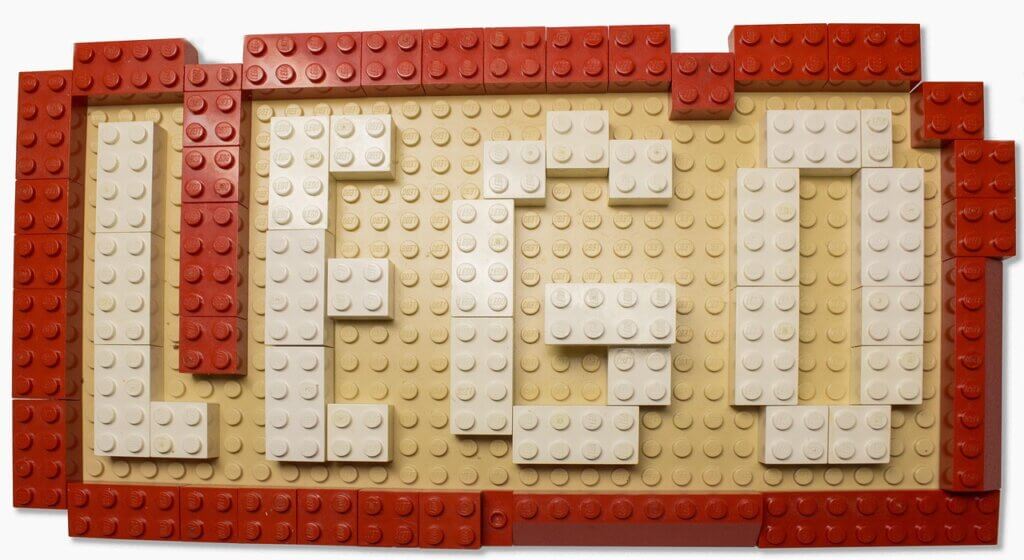
What “LEGO® brainstorming” looks like
Here are signs that a workshop is using LEGO® bricks but not authentic LSP methodology:
❌ “We’ll use LEGO® bricks to make the session more creative and fun” – LSP isn’t decoration; it’s the core methodology
❌ Group building from the start – Real LSP always begins with individual models
❌ No protected silence for building – People chatting while building means no genuine individual thinking time
❌ Optional participation – “Share if you’d like” isn’t LSP
❌ Focus on the final product – Real LSP focuses on the process and insights, not creating a “solution model” to keep
❌ Facilitator explaining what your model means – In authentic LSP, only you explain your model’s meaning
❌ LEGO® as just one activity among many – “We’ll do some LEGO® building, then break into discussion groups…” suggests LEGO® is a warm-up, not the methodology
❌ Building whatever you want – Real LSP has specific prompts and questions; you’re responding to a challenge, not free-building
The tricky question of workshop length
Here’s where it gets nuanced. I often see people dismiss short workshops as “not real LSP” based purely on time. But the truth is more complex.
Can you do authentic LSP in 2 hours?
Yes, if you have a very small group (typically 6-8 people maximum) and a tightly focused question or topic. With a small group, you can complete the full LSP cycle authentically within 2 hours:
- Warm-up exercises (15-20 minutes)
- One or two rounds of Challenge-Build-Share-Reflect (60-90 minutes)
- Documentation and closing (15-20 minutes)
However, most 2-hour workshops I see advertised are for larger groups (15-30+ people), and that’s where the math simply doesn’t work. If you have 20 people and each person shares for just 3 minutes, that’s already 60 minutes, leaving no time for building, warm-up, or reflection.
Red flags in short workshops:
- Large group size (15+ people) in 2 hours
- Multiple complex questions promised in 2 hours
- No mention of group size limits
- Claims like “perfect for teams of any size”
What to ask:
- “How many participants will there be?”
- “How many complete LSP cycles will we go through?”
- “How much time is allocated for sharing?”
For more complex challenges, deeper exploration, or larger groups, you need half-day (3-4 hours) or full-day (6-8 hours) workshops to do LSP justice.
When “LEGO® brainstorming” might be fine
Here’s an important point: Not every LEGO®-based workshop needs to be authentic LSP. Sometimes a creative session using LEGO® bricks as a thinking tool is exactly what you need, and that’s perfectly legitimate, as long as it’s not marketed as LEGO® Serious Play®.
LEGO® brainstorming or LEGO®-enhanced workshops can be valuable for:
- Quick creative ideation
- Team warm-ups and ice-breakers
- Adding tactile elements to other methodologies
- General creative problem-solving
The issue isn’t that these approaches are bad. The issue is misrepresentation, charging LSP prices and promising LSP outcomes for something that isn’t the rigorous methodology.
Why authenticity matters
You might wonder: does it really matter if someone follows the exact methodology, as long as we’re using LEGO® bricks and having good conversations?
Yes, it matters. Here’s why:
1. You’re paying for specific outcomes Authentic LSP has been researched and validated. It creates psychological safety through specific mechanisms. It ensures equal voice through specific structures. It accesses deep thinking through specific techniques. “Playing with LEGO®” doesn’t guarantee these outcomes.
2. Depth vs. surface Real LSP goes deep. The metaphorical thinking, the protected silence, the structured reflection—these create insights that casual LEGO® brainstorming simply doesn’t reach. If you’re paying for transformation, you deserve the methodology that delivers it.
3. Inclusion and equity The LSP structure was designed to democratize participation. When facilitators skip the rigorous process, they often revert to the same participation patterns LSP was designed to disrupt—loud voices dominating, quiet voices disappearing.
4. Respecting the investment LSP workshops aren’t cheap. You’re investing time, money, and team energy. You deserve facilitators who’ve invested in proper training and who respect the methodology enough to implement it faithfully.
What good facilitation looks like
When you work with a facilitator who truly knows LEGO® Serious Play®, you’ll notice:
Before the workshop:
- Clear communication about process, time requirements, and outcomes
- Questions about your specific challenge and goals
- Transparency about group size limits
- Explanation of what makes LSP appropriate (or not) for your situation
During the workshop:
- Visible structure to the process
- Protected silence for building
- Everyone participates equally
- Focus stays on the models, not the people
- Skillful questioning that deepens thinking
- Respectful time management
After the workshop:
- Documentation of insights (often including photos of models)
- Clear next steps or action items
- Tangible shifts in how the group relates to each other
- Participants reporting they felt heard and that the process generated new insights
Trust your instincts
If something feels off, trust that feeling. If the workshop seems like “creative fun with LEGO®” but lacks rigor, if not everyone is participating, if it feels more like entertainment than methodology—you’re probably right.
Good LSP should feel both playful AND profound. Light AND deep. Structured AND creative. If you’re only getting one side of that equation, question whether you’re experiencing authentic methodology.
Ready to experience LEGO® Serious Play® ?
If you’re considering an LSP workshop for your team and want to discuss whether it’s the right fit for your needs, or if you have questions about what authentic LSP looks like in practice, I’d be happy to talk.
I believe in this methodology because I’ve seen what it can do when implemented with integrity. And I believe you deserve to experience the real thing.#