This article was originally written in English. If your browser is set to Dutch, it may be translated automatically. Please note that automated translations may contain grammatical errors or inaccuracies.
Good Comms receives the Bridge Builder distinction
Of all the things a LEGO® Serious Play® workshop could be recognised for, I hadn’t expected the string.
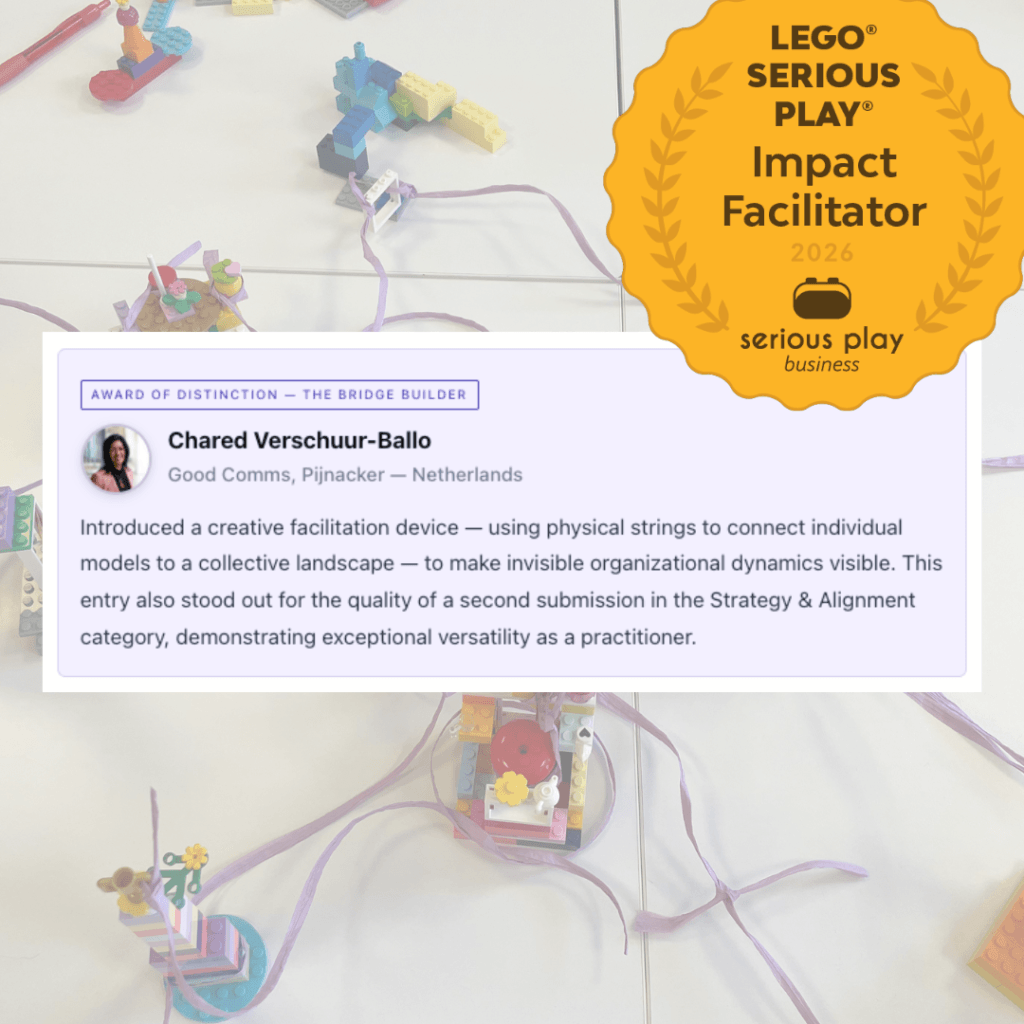
Good Comms received the Bridge Builder Distinction at the inaugural LEGO® Serious Play® Global Facilitation Excellence Awards, organised by Serious Play Business this year (2026). The judges highlighted how I invite participants to connect their individual models with string so they can see how their ideas, perspectives, and work relate to one another. Read the awards announcement.
The name made me smile. Create understanding, build bridges, and break barriers is the idea I founded Good Comms on. Building bridges was there from the beginning. The string came later.
What a piece of string can show you
In a LEGO® Serious Play® session, each person builds a model and tells the story behind it. Once the stories are on the table, I sometimes bring out the string and ask, What is your model connected to?
Imagine two colleagues linking their models because they’re working towards the same goal. One explains what they need from the other. The other says, ‘Oh, is that what you’ve been waiting for?’
At that point, the string has done about as much as a piece of string can reasonably be expected to do. The group can take it from there.
A gap between two models can be as interesting as a tangle of connections. Perhaps two teams thought they were working on separate problems. Perhaps someone assumed a colleague was already involved. With the models in front of them, the group can point to a particular gap and ask what’s going on there.
The same work in three different rooms
I entered three cases, in Team Development, Strategy & Alignment, and Community Contribution. The judges also praised my Strategy & Alignment submission and commented on the versatility of the work. I liked that. From where I stood, it felt like the same work in three very different rooms.
- At Rijksvastgoedbedrijf, the B&U team started with individual strengths and built a shared vision, identified areas of focus, and agreed on actions.
- In Paris, the IABC EMENA board brought its individual visions together and agreed on three shared priorities.
- On Diversity Day, a department at the Municipality of The Hague explored identity and privilege, then built a shared picture of what an inclusive workplace could look like.
I first learnt to ask whose voice was missing when I worked as a journalist. Years later, a participant in my research on belonging gave me three words I still come back to: ‘my voice matters’. A workshop gives that idea a practical test. Once everyone has had a turn to speak, can people see where their contributions went? Did something they said change a priority, sharpen a question, or help someone see the situation differently? Read more about the belonging research.
That’s what makes this particular distinction special to me. I care about what a bridge enables people to do together once they’re connected. In these three rooms, that meant turning individual strengths into a plan, choosing where to focus as a board, and giving people a way to talk about what inclusion would look like in their own workplace.
Thank you to all three groups for trusting me with those conversations, and to everyone who picked up a brick and said what they actually thought. The distinction is yours as much as mine.
Try it at your next team meeting
Pick a question your team is already working through. Ask everyone to choose a small object from the room and explain how it represents their view of the situation. Then use string or tape to mark the connections people see between the objects.
Take a moment to look at the table together. Which connection surprised you? Which one did you expect to see but can’t find? Choose one that could change how you work together and agree what you’ll do about it.
If your team, board, or community has a question worth putting on the table, get in touch to explore a co-creation session.